Language Issues in Science
This was the first component of the Language and Learning course of the B.Sc Honors in Science Education completed at the University of the Witwatersrand.
The course looked at the issue of language and science learning. The assignments were aimed at developing the skill of developing an argument to support assertions.
Professor Samuel Ooyo wrote that:
Science at school level is largely viewed as a practical subject – one that is taught using experiments, for instance. But effective teaching and learning requires language, whether it’s written in textbooks or shared orally during classroom discussions. Language is necessary even while doing practical work: teachers must explain what they are doing and students need to ask questions.
Research involving a wide range of educators in a number of countries has consistently found that teachers do most of the talking in classrooms. Language plays a crucial role in the formation and development of concepts. This suggests that a teacher’s language is vital in teaching science and creating the condition for meaningful learning.
The language of teaching and learning
In South Africa and other countries where many pupils do not learn in their home language, curriculum designers have judged the appropriateness of the language in which science is taught by considering whether it is the learners’ mother tongue or not.
Students learning in their mother tongue are generally thought to have an advantage over their counterparts who are being taught in a second or third language.
The general assumption among teachers is that all learning follows through smoothly once learners have attained some proficiency in the language of learning and teaching. But not everyone who is proficient in the language of teaching and learning – for instance, English – excels in science.
The anatomy of words in the classroom
The words that comprise the science classroom language fall into two broad components: the technical and non-technical. The former comprises technical words which are specific to a science subject or discipline: photosynthesis, respiration and genes in biology; momentum, capacitance and voltage in physics; atoms, elements and cations in chemistry. When used as science terms, every day words attain new meanings. They become science words.
The non-technical component is made up of non-technical words and defines or gives identity to the particular language of learning and teaching in a classroom or the language of a science text. Some of these non-technical words give identity to certain science subjects where they are used to embody a particular concept important to a process of learning in the specific science subjects: “reaction” in chemistry, “diversity” in biology and “disintegrate” in physics.
The difficulty of the science classroom’s language
Science is considered a difficult school subject. This is partly because pupils find science words tough or unfamiliar. They are also confused when a word that means one thing in everyday language means something different in science. “Resistance”, for instance, means something totally different in everyday language and in physics.
They will also be puzzled when a non-technical word seems to have acquired a meaning specific to the context of a particular science subject. “Disintegrate” when used in physics does not refer to something “breaking into lots of very small pieces”. Even children who speak English as their first language and are learning science in English struggle because of these differences.
A review of relevant research shows that students struggle with the language of the science classroom because of these differences whether they are learning in their home language or not. Boys and girls struggle equally. Pupils battle irrespective of their individual cultural backgrounds.

Assignment One
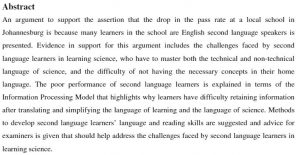
An Argument in Support of the Assertion that the Decline in the National Pass Rate in Science can be Attributed to the Problem of English as a Second Language for many Science Learners
Assignment Two
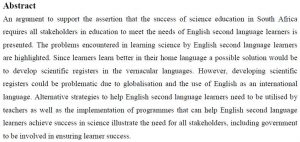
An Argument in Support of the Assertion that Success in Science Education Requires Stakeholders to Meet the Needs of Second Language Learners
Assignment Three
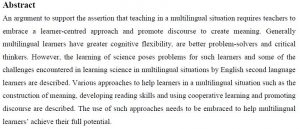
An Argument in Support of the Assertion that Teaching in a Multilingual Classroom Requires Teachers to Embrace a Learner-centred Approach and Promoting Discourse to Create Meaning
Assignment Four (Exam Equivalent)
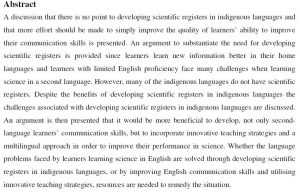
A Discussion on Developing Scientific Registers in Indigenous Languages or Developing English Communication Skills to Improve English Second-Language Learners’ Performance in Science
Assignment Five (Exam Equivalent)
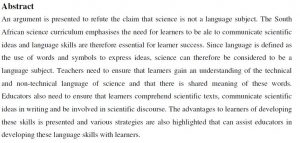
An Argument to Dispel the Notion that ‘Science is not a Language Subject’ and Highlight the Responsibility of Science Teachers in Developing Language Skills in Science to Ensure Learner Achievement
Useful Resource
Language Skills in the Science Classroom